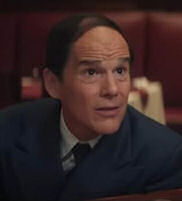
A descent into despair, as performed by a prisoner of passion and his tormentors.
Richard Rodgers and Lorenz Hart worked together for 24 years, creating 28 musicals and over 500 songs. However, due to Hart’s alcoholism, Rodgers formed a team with lyricist Oscar Hammerstein II, a pairing that would become the most successful in Broadway history. The first fruit of this collaboration was “Oklahoma!” which opened on Broadway in March of 1943, to critical and public acclaim.
Director Richard Linklater has made a film, not about Rogers & Hammerstein, but about Lorenz Hart, all taking place in the legendary Sardi’s, a bar and restaurant just down the street from the famed theaters of Broadway.
Hart (Ethan Hawke) was attending the opening night of “Oklahoma!” – a musical he’d been offered to write – but which he’d turned down as too insipid. He is presented here as a man with a masterful grasp of language and a cynically humorous opinion of the world.
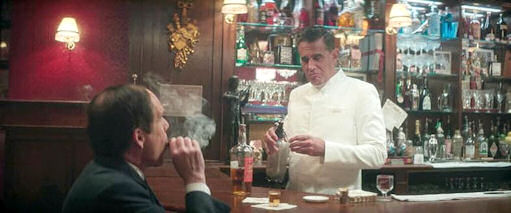
He also has two terrible weaknesses: he is an alcoholic, and he is, under the cynicism, a romantic. The alcoholism seems a contradiction to his spending this evening in a famous bar, but there is a friendly barman (Bobby Cannavale – “Unstoppable”) who resists over-serving him and who stands in for everyman with a sarcastic wit on par with Hart’s. However, Sardi’s was where all the theatrical greats gathered and for Hart it was a second (or first?) home.
The romantic weakness takes two forms: a young co-ed, Elizabeth Weiland (Margaret Qualley – “Fosse/Verdon”), Hart’s protege’ with whom he is madly in love (he’s twice her age) and whom she loves, “but not in that way”; and Richard Rogers (Andrew Scott – “Wake Up Dead Man”), Hart’s former partner.
Writer Robert Kaplow (“Me and Orson Welles”) has written a marvelous (and Oscar nominated) screenplay, inspired by his discovery of letters sent between Weiland and Hart. It beautifully captures the growing desperation and sense of foreboding that surrounds Hart as he carries on his monologue of memories, hopes and resentments to his three captive listeners in the bar – the barman, a young soldier playing Richard Rogers tunes on the piano, and writer E.B. White (Patrick Kennedy – “Miss Marx”).
And here I have a major gripe with this type of biographical script: whether White was in fact present on this generally fabricated evening is not important. However, Kaplow invents a conversation between Hart and White that clearly intimates that Hart is responsible for giving White the idea behind his famous children’s story Stuart Little” — something that’s simply not true. This kind of manipulation of factual history is inappropriate.
Hawke, almost unrecognizable in all the makeup and comb-over wig, gives us a sterling performance as the tormented and doomed lyricist (he was dead of pneumonia seven months after this night), well worthy of the best Actor Oscar nomination he’s received.
This movie, basically a photographed stage play, is not for general audiences used to interstellar battleships blasting the lives of hundreds in the depths of outer space. The pathetic box office results attest to that. However, if you are interested in the interplay of words and the depth of hidden human emotion that can be presented through superior writing and acting, this film is for you.
RuntimeL One hour, 40 minutes
Availability: In select theaters, streaming on Netflix.
. . .
Join us on Facebook at
http://www.facebook.com/itsjustmovies!