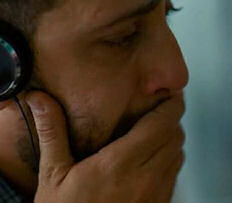
If there is no other film you see this year, see this one. It’s more important and more dramatic than any other. This is because it’s true, based on first-hand accounts, encompassing a moral dilemma, and its human response.
Even if you’ve seen all the Golden Globe and Oscar-nominated films, even if you are saturated with drama, disgust, inspiration, and insight, still … see this one.
“The Voice of Rajab” is a docu-dramatization of what happened on Jan. 29, 2024.
On that day, a call for help came into the Palestine Red Crescent Society (PRCS). The agency is located in Ramallah, the capital of the occupied West Bank (aka Palestine), but it serves all the occupied lands, including Gaza, through remote technology.
A call comes and is immediately tracked on a digital map that shows location. A woman is reporting an ambush in northern Gaza and wants help. In order to assist her without risking the lives of those rushing to her aid, the coordinator at the PRCS must relay the request for help to the Red Cross, who then contacts the Israeli army, who then relays back to the Red Cross, who gets back to the PRCS. It is in this way that if a woman goes into labor or someone is having an immediate health issue, an ambulance may have safe passage.
The problem is that it all takes time, and many intermediaries are involved. Soon, over the phone gunshots are heard, and the line on this particular call goes dead. The guy taking the call is shaken. He begins the process of grief, recovery, and respect.
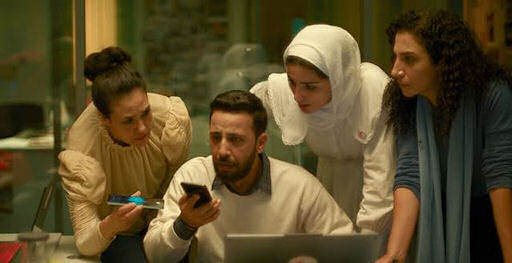
The staff at the PRCS are not hardened. They have rituals, like finding pictures of the victims and putting them up on a board with their names. They work long hours, and they have a staff counselor whose first priority is to sustain the emotional well-being of each person serving at the center.
Then surprise. A call comes in from the same phone number that had gone dead. It is 5-year-old Hind Rajab. She has survived the attack on her family and asks for someone to come rescue her. We hear her real voice. She is still in the car. Every word we hear through the telephone is the actual recording of this child – every word is hers.
The story of Hind Rajab personalizes the entire situation in Gaza. Except for the ending, the entire gripping film takes place in Ramallah’s Red Crescent office as they organize an ambulance to travel through decimated streets to find her.
As part of my instruction as a Model United Nations coach, my students were taught the Rules of War as established in 1949. All major countries signed. As AI summarizes, it aims to protect “those not or no longer fighting, including civilians, the wounded, prisoners of war, and medical staff, by prohibiting torture, targeting civilians, and restricting weapons, while demanding humane treatment, proper care for the sick, and humanitarian access for aid. These international laws, agreed upon by nearly all nations, apply during armed conflicts and form the core of International Humanitarian Law.”
Yes, the United States has broken this law. What can anyone do about it? But each time it does, it loses respect and moral authority in an ever-increasingly chaotic world. It also loses its ability to hold anyone else accountable.
So, in this film’s case, in a breach of the Geneva mandate, a civilian car was targeted and machine-gunned, in an attempt to kill all the adults and children in it.
But the world already knows an entire region has been bombed and leveled. We know all about the repeated blocks to humanitarian aid, as well as the bombing of the World Central Kitchen team that had gotten prior permission for their travel route.
The Israeli army and secret service are famous for getting their man. That they couldn’t root out just Hamas but have had to kill an entire population simply goes against the Geneva Convention.
Just like Seymour Hersh documented the My Lai Massacre, the Abu Ghraib prison abuse, and the Secret Bombing of Cambodia, writer/director Kaouther Ben Hania has documented a war crime in “The Voice of Hind Rajab,” that, my friends, was paid for with our tax dollars.
This is the most important film of the year.
10/10
Credits
Writer/Director: Kaouther Ben Hania
Producers: Nadim Cheikhrouha, Odessa Rae, and James Wilson
Director of Photography: Juan Sarmiento G.
Editors: Qutaiba Barhamji, Maxime Mathis, and Kaouther Ben Hania
Music: Amine Bouhafa
Cast: Saja Kilani (Rana Hassan Faqih), Motaz Malhees (Omar A. Alqam), Amer Hlehel (Mahdi M. Aljamal), Clara Khoury (Nisreen Jeries Qawas).
Submitted to the Oscars by Tunisia/France.
In Arabic with English subtitles.
Released: Dec. 4, 2025
Official Website and how to view: https://www.thevoiceofhindrajabfilm.com/home/
. . .
Join us on Facebook at
http://www.facebook.com/itsjustmovies!