 Why is this archival documentary called “Bernstein’s Wall”?
I suspect those who saw Bradley Cooper’s “Maestro” will be the first to see this new film about America’s greatest conductor, Leonard Bernstein, who brought great classics to passionate new life and composed the score to America’s most exciting musical, “West Side Story.”
Because Bernstein was so endeared, and yet also so controversial, Cooper’s biopic of him caused foment amongst the purists. Many were upset that Bernstein’s active support of civil rights, crusade against the Vietnam War, advocacy for nuclear disarmament, and financial fundraising for HIV/AIDS were not a focus. Curiously, the biggest upset seemed to come from those offended that Cooper used a prosthetic nose.
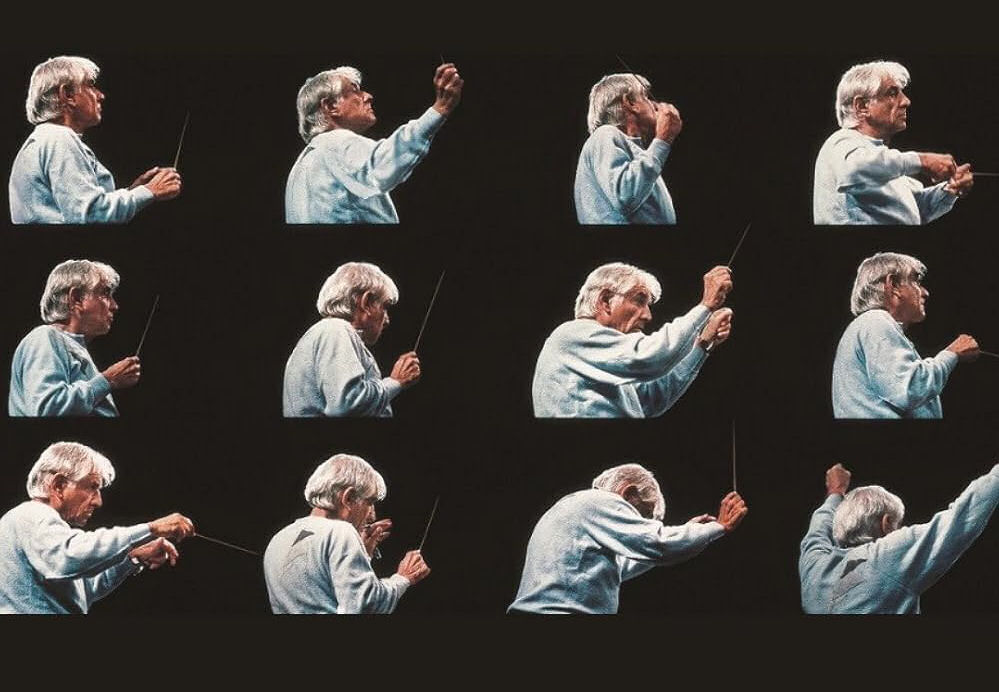
But Douglas Tirola’s “Bernstein’s Wall” may cure all complaints. He covers the composer’s life without dramatization or anyone else’s opinion. As a matter of fact, it is primarily in Bernstein’s own voice with archival clips and photos.
But it’s the title for this documentary that deserves some analysis. There are at least three ways to understand it. Each way reveals the depth Tirola went to deliver the most accurate life possible of an outstanding American composer, activist, and humanist.
The first way to understand the title is as a political play on the Berlin Wall. Bernstein regarded himself as a cultural diplomat, using music to educate audiences and bridge ideological divides. In 1989, he famously traveled to Berlin on Christmas Day, 6 weeks after the fall of the Berlin Wall. There, he conducted a televised performance of Beethoven’s Symphony No. 9 in East Berlin. To symbolize peace and the triumph of democracy, his orchestra was a composite group featuring musicians from both East and West Germany, as well as the four Allied powers: the U.S., UK, France, and the Soviet Union. In a bold move, Bernstein changed the lyric of the famous “Ode to Joy” (Ode an die Freude) to “Ode to Freedom” (Ode an die Freiheit), remarking that Beethoven would have given his blessing to the change. After the performance, he went to the Berlin Wall and used a hammer and chisel to chip off some of the wall. In the end, Bernstein achieved an identity with the wall, and perhaps the title alludes to that.
Second, “Bernstein’s Wall” explores the many “walls” Bernstein faced in his own life, including his struggle to balance his public persona with his hidden sexual identity, infidelities, and promiscuity. His early challenges include having a father who was harsh and unable to express affection. He did not support Bernstein’s obvious musical talent. Plus, after Bernstein graduated from Harvard and the Curtis Institute of Music in Philadelphia, he could not find a job. Upon trying to serve in WWII, he was rejected due to asthma.
In addition, culturally, there were early barriers he faced as a Jewish artist in America. Early in his career, he even considered changing his name to “Leonard S. Burns” to overcome antisemitism.
But a third explanation for the title that seems to me to fit best is that “Bernstein’s Wall” alludes to something more existential and spiritual. Because it is an unflinchingly honest story by Bernstein himself through his own interviews, letters, and archival footage, showing the depth of his self-involvement and conflicted conscience, it seems that it is, in essence, both a confession and a prayer, and, in that way, a reference to the Wailing Wall in Jerusalem where many have gone to pray and ask forgiveness.
Credits
Director: Douglas Tirola
Writers: Douglas Tirola and Leonard Bernstein (archival words)
Producer: Susan Bedusa
Executive Producers: Michael Bloom, Maria Zuckerman, Ryan Heller, Lisa Leingang, David J. Cornfield, Linda A. Cornfield, John Boccardo, and Derek Esplin
Editor: Zachary Obid
Composer: Peter Golub
Production Companies: Topic Studios, 4th Row Films, and Fit Via Vi Film Productions
Release: April 24, 2026
. . .
Join us on Facebook at
http://www.facebook.com/itsjustmovies!